
Is Your Battery Installation Ready for October 2026?
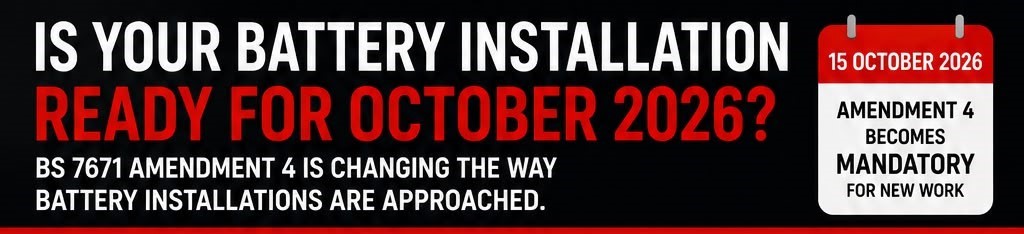
What BS 7671 Amendment 4 means for UK battery installers
The UK battery-storage market is moving quickly.
More homes are installing solar PV alongside battery energy
storage systems (BESS), and installers are increasingly having to consider not
just the electrical design of a system, but also where the battery is
located, how it is protected and how the installation manages fire risk.
For installers, an important change is approaching.
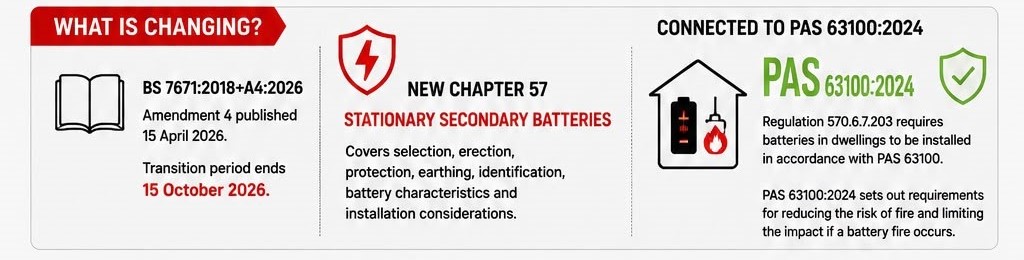
BS 7671:2018+A4:2026 — Amendment 4 to the 18th Edition
Wiring Regulations — was published on 15 April 2026. The current transition
period ends on 15 October 2026, after which Amendment 4 must be used for
new work.
That makes the next few months an important period for
anyone designing or installing battery-storage systems.
What is changing?
One of the significant changes in Amendment 4 is the
introduction of a new:
Chapter 57 — Stationary Secondary Batteries
This new chapter addresses stationary battery installations
where batteries are used for the storage and supply of electrical energy.
It covers areas including:
• Selection
and erection of equipment
• Protection
against electric shock
• Protection
against thermal effects
• Protective
earthing
• Identification
and notices
• Battery
characteristics
• Installation
considerations
The IET specifically identifies Chapter 57 as a major
addition to Amendment 4.
For domestic battery installations, there is an especially
important connection.
PAS 63100:2024
The IET’s information on Amendment 4 states that Regulation
570.6.7.203 requires stationary secondary batteries in dwellings to be
installed in accordance with PAS 63100.
This is why PAS 63100:2024 is becoming increasingly
important for battery installers.
What is PAS 63100:2024?
PAS 63100:2024 is the BSI specification covering:
Electrical installations — Protection against fire of
battery energy storage systems for use in dwellings.
It was published on 20 March 2024 and provides requirements
intended to help installers manage the fire-related hazards associated with
domestic BESS installations.
It covers areas including:
• Battery
units
• Battery
management
• Power
conversion equipment
• Fault
management
• Installation
location
• External
influences
• Protection
against fire
BSI describes the purpose as helping reduce the risk of
batteries becoming a source of ignition and limiting the impact if a battery
fire occurs.
Why does battery location matter?
The conversation around battery storage is changing.
Historically, much of the installation discussion has
concentrated on:
“Can we physically fit the battery here?”
The increasingly important question is:
“Is this an appropriate location for the battery?”
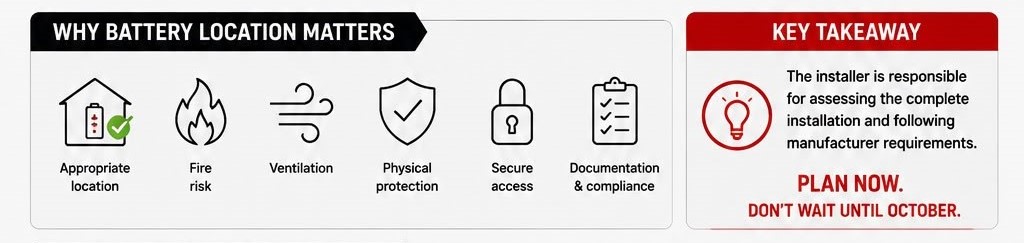
Installers need to consider the surrounding environment,
access, ventilation, combustible materials, proximity to the dwelling and other
potential fire or physical hazards.
This doesn’t mean that every battery installation needs the
same enclosure.
It means that the installation needs to be assessed as a
complete system.
Where does Solar-Cage fit in?
At Wireguards UK, we’ve been developing the Solar-Cage™
range around this changing installation environment.
Rather than simply creating another security cage, our
objective is to provide installers with a purpose-designed battery and inverter
protection system that can form part of a properly designed installation.
Our range currently consists of two principal solutions:
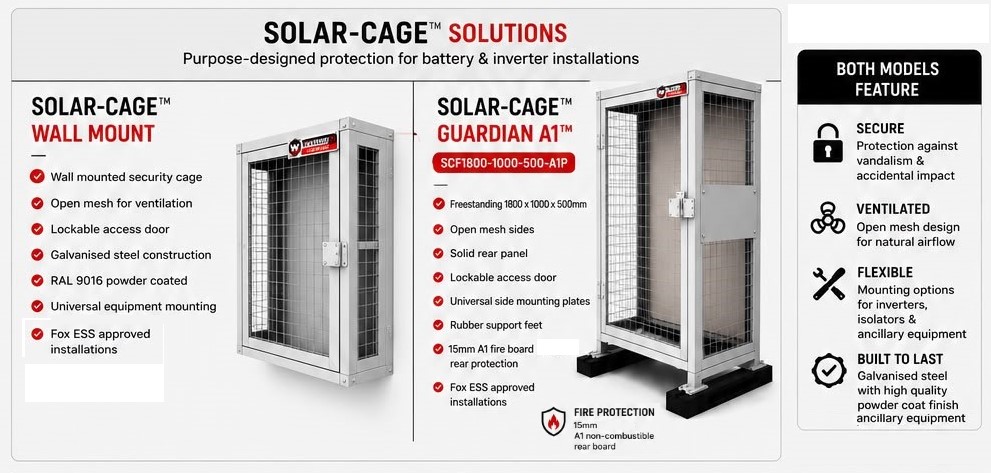
Solar-Cage™ Wall Mount
The Wall Mount is designed for installations where the
battery and inverter can be safely positioned against a suitable external wall.
The enclosure provides:
• Secure
lockable access
• Physical
protection
• Open
mesh ventilation
• Galvanised
steel construction
• RAL 9016
powder-coated finish
• Equipment
mounting options
• Optional
rear fire-barrier configuration
The enclosure is designed around the principle that the cage
should protect the equipment without unnecessarily compromising ventilation or
manufacturer-specified clearances.
Solar-Cage Guardian A1™
The Guardian A1 takes the concept further.
It is a freestanding 1800 × 1000 × 500 mm enclosure designed
for installations where wall mounting isn’t suitable or desirable.
The concept incorporates:
• Freestanding
construction
• Open
mesh sides
• Solid
rear panel
• Lockable
access
• Galvanised
steel
• RAL 9016
finish
• Universal
equipment mounting plates
• Rubber
support feet
• 15 mm
A1 fire-board rear protection*
The Guardian therefore gives installers another option when
designing an external battery installation.
*The final
fire performance of any installation depends on the actual board, thickness,
fixing method, substrate and complete assembly. An A1 classification is a
reaction-to-fire classification. It should not automatically be interpreted as
a 30-minute fire-resistance rating. Therefore, Wireguards UK will only make
specific fire-performance claims where the supporting evidence for the
particular configuration exists.
A more flexible approach to installation
The Guardian A1 has also been designed around the idea that
installers may need to accommodate different ancillary equipment.
Universal mounting plates can provide fixing locations for:
• Isolators
• Junction
boxes
• Monitoring
equipment
• Communication
equipment
• Other
associated electrical equipment
This avoids having to drill or modify the main cage
structure on site.
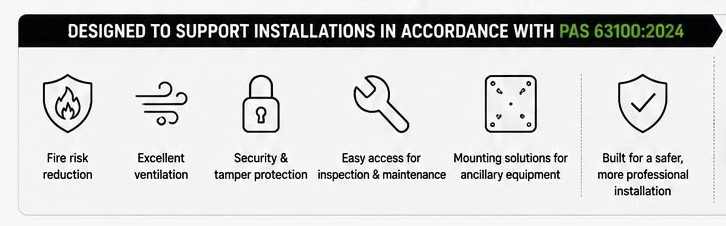
Designed around PAS 63100:2024 principles
Although Solar-Cage is not itself a PAS 63100 certification
(PAS 63100 applies to the complete BESS installation), the cage is one
component within that installation.
Solar-Cage has been designed to support installations in
accordance with PAS 63100:2024.
October 2026: the date installers should have in their diary
The important date is:
15 OCTOBER 2026
Amendment 4 was published in April 2026, but the IET
confirms that the existing version remains valid during the transition period.
From 15 October 2026, Amendment 4 must be used for new work.
That gives installers a relatively short window to
familiarise themselves with the new requirements.
What should installers be doing now?
We would suggest reviewing your battery installation process
now!
Consider:
1. Battery location
Is the proposed location appropriate?
2. Manufacturer requirements
Are the battery and inverter manufacturer’s clearances and
ventilation requirements being maintained?
3. Fire risk
What is immediately surrounding the battery?
4. Physical protection
Could the equipment be damaged, tampered with or struck?
5. Access
Can the equipment be safely accessed for inspection and
maintenance?
6. Documentation
Can you demonstrate how the installation was assessed?
7. Future installations
Do you have a standardised enclosure solution for locations
where additional protection is appropriate?
The Solar-Cage approach
This is the thinking behind Solar-Cage.
We don’t believe there should be a one-size-fits-all battery
enclosure.
Instead, installers need options.
Wall Mount
For suitable wall-mounted installations.
Guardian A1
For freestanding external installations, or where an
additional rear fire-protection layer is appropriate.
Together, these provide a more flexible approach to external
battery installation.
Preparing for the next generation of battery installations
The introduction of Chapter 57 and the connection between BS
7671 and PAS 63100 represent an important development for the UK
battery-storage industry.
For installers, the message is simple:
Don’t wait until October to review your installation
approach.
Start looking now at:
Location → Fire risk → Ventilation → Protection → Access →
Documentation
And where an external enclosure is appropriate, consider
whether a purpose-designed system can make the installation more secure,
consistent and professional.
SOLAR-CAGE™
Battery & inverter protection for the next generation
of UK installations
Wall Mount | Guardian A1™
Designed to support installations in accordance with PAS
63100:2024
Wireguards UK
wireguardsuk.co.uk
